
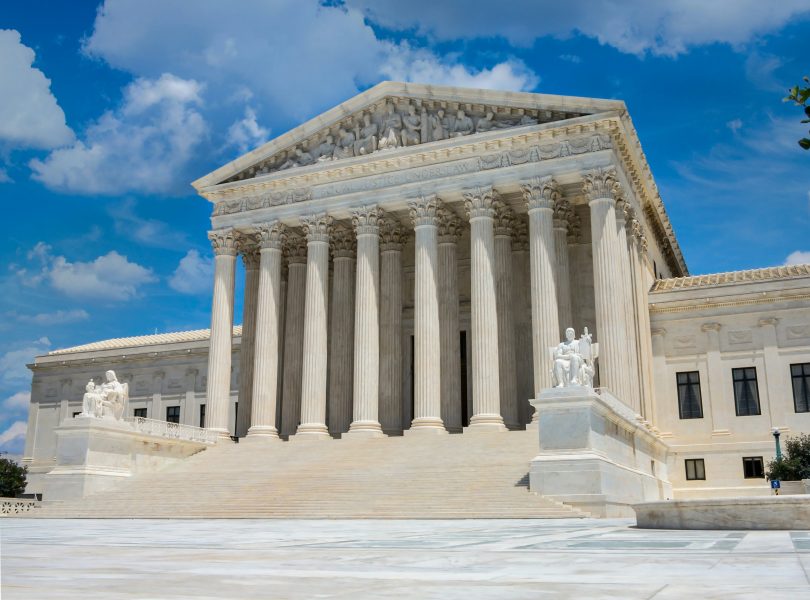

The Supreme Court of the United States decides roughly 60 to 80 cases per year out of the approximately 7,000 to 8,000 petitions it receives. That means the circuit courts — the twelve regional courts of appeals that sit below the Supreme Court — have the last word on the vast majority of federal legal questions. What they say about constitutional interpretation, federal statutory authority, and civil rights becomes the law that actually governs most Americans’ lives, most of the time.
But when the circuits disagree with each other — or when a single circuit issues a ruling so consequential that the stakes demand final resolution — those cases become the pipeline to One First Street. Understanding which lower court rulings are currently in that pipeline is one of the most useful things anyone who follows the law can do. The current pipeline is unusually full, touching executive power, birthright citizenship, independent agency governance, and First Amendment rights in digital spaces. Several decisions now working their way through the system could reshape American law at a constitutional level for a generation.
Key Takeaways
- The D.C. Circuit’s December 2025 ruling in Wilcox v. Trump — holding that statutory for-cause removal protections for NLRB and MSPB members are unconstitutional — feeds directly into Trump v. Slaughter at the Supreme Court, where oral argument occurred in December 2025 and a ruling is expected by late June 2026 on whether Humphrey’s Executor should be overruled.
- Multiple circuit courts — including the Fourth Circuit and Ninth Circuit — struck down President Trump’s birthright citizenship executive order as facially unconstitutional under the Fourteenth Amendment, producing the case Barbara v. Trump, argued at the Supreme Court on April 1, 2026, with a ruling expected by July 2026.
- The Fifth Circuit and Eleventh Circuit reached opposite conclusions on state social media content moderation laws, creating the circuit split that sent NetChoice v. Paxton to the Supreme Court — which remanded for further proceedings in 2024, setting up a likely second Supreme Court appearance when those circuits rule again.
- The Sixth Circuit in Brown-Forman Corp. v. NLRB (March 2026) held that the NLRB exceeded its authority, creating a circuit-specific limitation on bargaining orders that signals growing judicial scrutiny of NLRB adjudications more broadly.
- A growing body of lower court rulings on state laws restricting gender-affirming care and transgender participation in sports has created genuine circuit tension that the Supreme Court is actively resolving in Little v. Hecox and related cases.
- The Supreme Court’s 2025 tariff ruling, where the Court struck down the use of IEEPA to impose broad tariffs, emerged directly from lower court challenges by small businesses and 12 states — demonstrating how commercial litigation in district courts can produce landmark constitutional rulings in a single term.
The Most Consequential Pipeline Case: Humphrey’s Executor and Independent Agency Independence
The most structurally significant body of lower court litigation currently pending Supreme Court resolution involves the constitutional status of independent federal agencies — the FTC, NLRB, FCC, SEC, CPSC, and approximately two dozen others whose leaders Congress has historically protected from at-will presidential removal.
The lower court litigation that built this case to the Supreme Court has been extraordinary in its speed and constitutional stakes. When President Trump fired NLRB member Gwynne Wilcox and MSPB Chair Cathy Harris in early 2025, both sued for reinstatement. Lower federal courts initially ordered reinstatement, citing the 1935 precedent Humphrey’s Executor v. United States, which unanimously held that Congress can limit presidential removal authority for independent agencies. The Supreme Court in May 2025 stayed those reinstatement orders in an emergency unsigned order that stated “the Government is likely to show that both the NLRB and MSPB exercise considerable executive power” — signaling that the Court’s conservative majority was prepared to narrow or overrule Humphrey’s Executor.
The D.C. Circuit formalized that logic in December 2025. In Wilcox v. Trump, a divided D.C. Circuit panel held that for-cause removal protections for NLRB and MSPB members are unconstitutional, reasoning that both agencies wield “substantial powers that are both executive in nature” and therefore cannot be insulated from presidential removal under Humphrey’s Executor‘s narrower holding. The panel read the 1935 case as protecting only agencies with purely advisory or quasi-legislative functions — a category so narrow it would leave few modern agencies covered.
This D.C. Circuit ruling feeds directly into Trump v. Slaughter, the FTC commissioner removal case the Supreme Court agreed to hear on an expedited basis, with oral arguments in December 2025 and a ruling expected by late June 2026. At oral argument, multiple justices questioned the ongoing validity of Humphrey’s Executor, and Justice Kagan’s dissent observed that the Court’s conservatives seem to be “raring” to overrule it. Solicitor General D. John Sauer described Humphrey’s Executor as “always egregiously wrong.”
The question is not just whether the FTC commissioner can be fired. It is whether Congress retains the constitutional authority to create agencies whose expert, nonpartisan members serve staggered terms insulated from day-to-day political pressure. The practical consequences of overruling Humphrey’s Executor would extend to the FCC, SEC, CPSC, EEOC, NLRB, and potentially to the Federal Reserve — whose governors the Supreme Court has tentatively carved out in a separate treatment, citing the Fed’s “distinct historical tradition” in language that has not yet been fully tested.
The lower courts built this case. The Supreme Court will deliver a verdict that will either preserve a 90-year constitutional architecture or dismantle it.
Barbara v. Trump: Four Circuits, One Constitutional Meaning
On January 20, 2025, President Trump signed Executive Order 14160, directing federal agencies to deny citizenship documents to children born in the United States to parents who are present unlawfully or on temporary visas. The order was intended to reinterpret the Fourteenth Amendment’s Citizenship Clause — “All persons born or naturalized in the United States, and subject to the jurisdiction thereof, are citizens” — in a way that would deny birthright citizenship to an estimated 300,000 to 400,000 children born in the U.S. annually.
Within hours, federal judges began blocking it. What followed was a cascading sequence of lower court rulings that set up one of the most important constitutional cases in decades.
A Washington State district judge issued a nationwide preliminary injunction within days, describing the executive order as contradicting “the plain language of the Fourteenth Amendment and the century-old untouched precedent that interprets it.” The Fourth Circuit blocked it in cases involving Maryland and New Jersey challengers. The Ninth Circuit upheld a nationwide injunction in a 2-1 decision. A New Hampshire district court issued a class-action injunction protecting all children born after February 19, 2025.
Every court to address the merits reached the same conclusion: the executive order is unconstitutional. The government’s theory — that “subject to the jurisdiction thereof” requires parental domicile and allegiance, not merely physical presence — was rejected at every level.
The Supreme Court intervened on a procedural question in Trump v. CASA (June 27, 2025), curtailing the use of universal nationwide injunctions without addressing whether the order itself was constitutional. That procedural ruling left the constitutional question open while simultaneously complicating the injunction landscape. The government then sought certiorari before judgment in Barbara v. Trump, the New Hampshire class action, and the Supreme Court granted review on December 5, 2025.
Oral argument occurred on April 1, 2026. The government argued that birthright citizenship depends on parental “domicile” and “political jurisdiction” — a framework that no court has ever applied. Both sides agreed that United States v. Wong Kim Ark (1898), which affirmed birthright citizenship for children of non-citizen residents, controls the case, but disagreed sharply on what that 127-year-old precedent actually holds. A ruling is expected by early July 2026.
The stakes are nearly singular. Birthright citizenship has been treated as settled constitutional law for over a century. An executive order has never previously attempted to modify it. If the Supreme Court upholds the order, the Fourteenth Amendment’s Citizenship Clause would mean something materially different from what it has meant for the entirety of American constitutional history. If the Court strikes it down — as every lower court has indicated it should — the ruling will definitively establish the constitutional limits of executive power over citizenship.
The NetChoice Remand: A Circuit Battle Still in Progress
One of the most consequential pending lower court proceedings isn’t a new case — it’s a remand. In July 2024, the Supreme Court vacated the judgments of both the Fifth Circuit (which upheld Texas’s social media content moderation law) and the Eleventh Circuit (which struck down Florida’s equivalent) in NetChoice v. Paxton and Moody v. NetChoice, directing both courts to conduct proper facial First Amendment analysis.
The Fifth Circuit’s original analysis was described by Justice Kagan as resting on “a serious misunderstanding of First Amendment precedent and principle” — the Supreme Court’s most pointed instruction to a lower court to reach a different result without technically ordering it. The majority’s opinion established that social media platforms engage in First Amendment-protected editorial judgment when moderating content, comparing their curatorial decisions to those of traditional editors and publishers.
Both the Fifth and Eleventh Circuits are now conducting that analysis on remand. When they rule — which is expected during 2026 — the decisions will determine whether Texas and Florida’s laws, which require large platforms to carry certain content regardless of their editorial policies, survive First Amendment scrutiny. Given the Supreme Court’s guidance, most legal analysts expect significant portions of both laws to be struck down, but the question of which specific provisions survive will shape every subsequent attempt by state governments to regulate social media content. And if the circuits still reach different enough conclusions, the case may return to the Supreme Court for a second time.
This matters well beyond Texas and Florida. Dozens of states have either enacted or are considering similar legislation. The Fifth Circuit’s posture — which previously upheld the Texas law with reasoning the Supreme Court found constitutionally flawed — makes it the most watched lower court proceeding for digital First Amendment law in the country.
Brown-Forman v. NLRB: Checking Agency Adjudication
Not all high-stakes lower court rulings are constitutional in character. The Sixth Circuit’s March 2026 decision in Brown-Forman Corp. v. NLRB represents a different category of lower court check on federal agencies — one that does not require a constitutional holding but that creates an immediate circuit split with significant practical implications.
The Sixth Circuit vacated an NLRB bargaining order, holding that the Board had exceeded its authority by establishing a new union recognition standard through adjudication rather than formal rulemaking, and that the new standard contradicted governing precedent established in NLRB v. Gissel Packing Co. (1969). The court found the Board had effectively lowered the threshold for ordering an employer to recognize a union following pre-election unfair labor practices — a policy change the court held was unnecessary to resolve the specific case and therefore impermissible as adjudicative lawmaking.
The ruling immediately limits the NLRB’s ability to issue bargaining orders in the Sixth Circuit — covering Kentucky, Michigan, Ohio, and Tennessee. It does not, yet, bind other circuits. Whether other circuits will follow is an open question, and the divergence creates precisely the kind of circuit split that can generate Supreme Court review — particularly when the underlying question of how far agencies can develop policy through adjudication rather than rulemaking is one the Roberts Court has shown sustained interest in answering.
Gender-Related Laws and the Circuit Pipeline
A separate but equally active pipeline involves the escalating series of circuit court rulings on state laws restricting gender-affirming medical care for minors and transgender participation in sports. These cases present genuine circuit disagreements on both the applicable constitutional standard and how that standard applies to the specific interventions at issue.
The Supreme Court is directly addressing part of this in Little v. Hecox, a challenge to Idaho’s law prohibiting transgender girls and women from participating in female sports. The case presents the question of whether such restrictions violate the Fourteenth Amendment’s Equal Protection Clause, and the Court’s answer will constrain how circuit courts analyze the dozens of similar state laws in litigation nationwide.
Similarly, Chiles v. Salazar asks whether Colorado’s conversion therapy prohibition — barring therapists from attempting to change a minor’s sexual orientation or gender identity — violates the First Amendment’s free speech protections. The Tenth Circuit upheld the law; the Eleventh Circuit had previously reached a different conclusion on a comparable Florida law. The ruling in Chiles will either resolve or deepen that split.
The circuit courts have been the primary laboratories for this litigation, producing decisions that reflect both the doctrinal disagreement among judges and the speed at which state legislatures have moved. The Supreme Court cannot resolve every variant simultaneously. The cases it selects and how it rules on them will define the constitutional perimeter within which lower courts must operate on every related question for years.
How Lower Courts Shape the Law Before the Supreme Court Speaks
What the current docket illustrates is a feature of American constitutional law that observers can underestimate: by the time the Supreme Court issues a landmark ruling, the legal question has usually been developing in the lower courts for years. District court injunctions, circuit panel decisions, en banc reversals, circuit splits, and certiorari petitions create the factual record and legal argument that the Supreme Court then synthesizes.
The Supreme Court reversed lower court decisions in roughly 71% of the cases it heard between 2007 and 2023 — meaning the lower courts are often the wrong answer, but they are always the first answer. And because so few cases ever reach the Supreme Court, the lower courts are also the final answer on most legal questions that practitioners, businesses, and individuals have to navigate every day.
The cases currently in the pipeline — on independent agency governance, birthright citizenship, digital speech, and adjudicative agency authority — represent some of the most fundamental constitutional questions about the structure of the American government, the meaning of the Fourteenth Amendment, and the limits of executive power. Lower courts have staked out positions. Some will be reversed. Some will be affirmed. All of them are shaping the constitutional landscape that the Supreme Court will eventually define.

